
Let’s be honest — your day is probably packed. Between replying to emails, scheduling posts, doing research, and managing your to-do list, it often feels like you’re running but never catching up.
What if you could hand off the boring, repetitive parts of your day to an AI — and it would handle them faster than you ever could?
That’s exactly what free AI tools for beginners to automate daily tasks without coding make possible right now in 2026. And the best part? You don’t need to be a developer, a tech expert, or even particularly “good with computers” to get started.
In this guide, I’ll walk you through the best beginner-friendly AI tools that are completely free to use, how each one works in real life, and a simple step-by-step process to start saving hours every week — starting today.
Why Free AI Tools for Beginners to Automate Daily Tasks Without Coding Are Essential
A few years ago, automation was mostly for big companies with IT budgets and in-house developers. Today, things look very different. According to HubSpot’s blog, AI-powered automation has gone mainstream — and the best tools are now free or have very generous free plans.
Here’s why it makes so much sense for beginners specifically:
You save real, measurable time. Tasks like writing emails, summarising documents, or creating social media posts can take an AI seconds — and you 20–30 minutes.
Zero coding is needed. Modern no coding AI tools are built for everyday people. Most work through a simple text box — you type what you need, and the AI delivers.
They work on mobile. Many of the best AI productivity tools for beginners are fully mobile-friendly, so you can automate tasks straight from your phone during a commute. The learning curve is tiny. If you can use WhatsApp, you can use most of these tools.
One thing I noticed when I first started using AI automation tools for beginners: the biggest barrier wasn’t the technology at all — it was just getting started. Once you try even one tool for a real task, the habit builds naturally from there.
As Neil Patel’s blog has pointed out, smart professionals aren’t replacing their work with AI — they’re using these tools to eliminate the tedious parts so they can focus on what actually matters.
Free AI Tools for Beginners to Automate Daily Tasks Without Coding
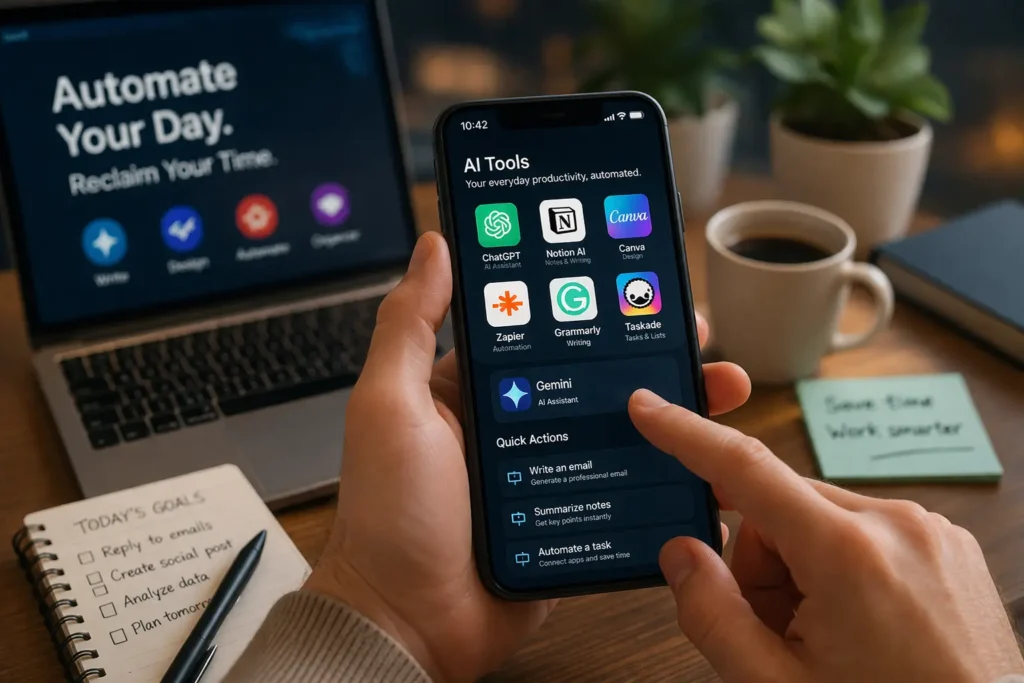
Below are seven of the best beginner AI tools in 2026 that are genuinely free to use (or have a solid free plan — no credit card required for the basics). I’ve tested each one and included honest notes on what works well and where you’ll hit limits.
1. ChatGPT — Best for Writing and Research
What it is:
ChatGPT by OpenAI is arguably the most well-known AI assistant in the world. It understands and generates human-like text across almost any topic imaginable.
How it works:
You type a prompt — a question, instruction, or piece of text — and ChatGPT responds with detailed, relevant content. It can draft emails, summarise articles, explain complex topics, rewrite content, translate languages, and much more.
Real-life example:
“Write a professional reply to this customer complaint email.” You paste the email, and ChatGPT gives you a polished, ready-to-send response in about 10 seconds.
Key features:
- Draft emails, blog posts, and social media captions
- Summarise long documents or articles
- Brainstorm ideas and create content outlines
- Answer research questions in plain, simple language
- Translate text between languages
Free plan limitations:
The free tier uses GPT-5.0 and has usage limits during peak hours. GPT-4o access on free accounts is limited daily.
Best use case:
Writing, content creation, research, and email drafting. This is the first tool I’d recommend if you want to use free AI tools for content creation without spending a penny.
2. Notion AI — Best for Notes and Project Planning
What it is:
Notion is a popular all-in-one workspace for notes, tasks, and databases. Notion AI adds an intelligent layer on top — it can write, edit, and summarise directly inside your workspace.
How it works:
Inside any Notion page, press the spacebar or type “/” and select an AI action. You can ask it to draft a meeting agenda, summarise your notes, turn a paragraph into bullet points, or translate a section of text.
Real-life example:
When I tested this tool with a messy set of meeting notes, it produced a clean, bulleted summary with action items in about 10 seconds. Honestly impressive for a free tool.
Key features:
- AI writing and editing inside your existing notes
- Auto-summarise long documents instantly
- Extract action items from meeting notes
- Convert free-form text into structured to-do lists
Free plan limitations:
Notion AI has a limited free trial; ongoing AI use requires an add-on plan. The base Notion workspace (without AI features) remains free.
Best use case:
Students, freelancers, and small teams who want to organise tasks and notes more efficiently without switching between multiple apps.
3. Zapier (Free Plan) — Best for Connecting Your Apps
What it is:
Zapier is the go-to platform if you want to automate daily tasks with AI — without writing a single line of code. It connects your apps and creates automated workflows called “Zaps.”
How it works:
You set up a trigger (e.g., “new email arrives in Gmail”) and an action (e.g., “save the attachment to Google Drive”). Zapier runs this automatically in the background, 24 hours a day, 7 days a week.
Real-life example:
Automatically save new Gmail attachments to a Dropbox folder, or post a tweet every time you publish a new blog post — all without lifting a finger after the initial setup.
Key features:
- Connects 6,000+ apps including Gmail, Slack, Google Sheets, and Notion
- Visual, drag-and-drop workflow builder
- AI-powered Zap suggestions to help beginners get started
- Multi-step automations for complex workflows
Free plan limitations:
The free plan allows 100 tasks per month and single-step Zaps only. More complex, multi-step workflows require a paid plan.
Best use case:
Anyone who uses multiple apps and wants them to talk to each other automatically. Brilliant for small business owners, freelancers, and bloggers who want to save time without any technical knowledge.
4. Canva AI — Best for Visual Content Creation
What it is:
Canva is a design platform used by millions of people worldwide. Its AI features — including Magic Write, Background Remover, and AI image generation — make visual content creation effortless for complete beginners.
How it works:
Log in, choose a template (social media post, presentation, flyer, banner), and let the AI tools help you fill in text, swap backgrounds, resize for different platforms, and generate custom visuals on demand.
Real-life example:
Type a prompt like “minimalist Instagram post about healthy breakfast recipes” and Canva generates an entire, ready-to-post design in under a minute.
Key features:
- AI image generation from text prompts
- Magic Write for captions and text suggestions
- One-click background removal
- Auto-resize designs for different social media platforms
- Thousands of free templates to start from
Free plan limitations:
Some AI features like unlimited Magic Write prompts are capped on the free plan. The Background Remover tool requires Canva Pro.
Best use case:
Content creators, bloggers, and small business owners who need professional-looking visuals without hiring a designer. It’s also worth exploring if you’re looking at free AI tools for video editing — Canva now supports short video creation too.
5. Grammarly AI — Best for Writing Polish and Email Drafting
What it is:
Grammarly is an AI writing assistant that checks your grammar, tone, clarity, and style in real time. Its newer generative AI features can now help you draft and rewrite text from scratch.
How it works:
Install the browser extension or use the web editor. Grammarly highlights issues as you type and suggests improvements. The AI can also generate full email drafts from a brief description.
Real-life example:
Writing a job application email? Type a rough draft, and Grammarly will fix the grammar, suggest a more professional tone, and rewrite weak sentences — all in seconds without you asking twice.
Key features:
- Real-time grammar and spell checking
- Tone detection (professional, friendly, confident, and more)
- Sentence rewrites for improved clarity
- AI email generation from short prompts
- Works directly inside Gmail, Google Docs, and most browsers
Free plan limitations:
Advanced suggestions including full tone rewrites and AI generation are mostly locked behind Grammarly Premium.
Best use case:
Anyone who writes regularly — students, professionals, bloggers, or non-native English speakers. It’s especially useful for polishing content if you’re using free AI tools for starting a blog.
6. Taskade AI — Best for Task Management and Planning
What it is:
Taskade is a collaborative productivity platform with a built-in AI agent that creates to-do lists, project plans, summaries, and mind maps on command.
How it works:
Ask the AI to generate a weekly plan, break a big project into smaller tasks, or summarise a document — and it builds a structured, fully editable list instantly.
Real-life example:
When I tested this, I typed “plan a 30-day social media content calendar for a food blog” and got a clear, week-by-week breakdown in about 8 seconds. Very useful for content planning and client projects.
Key features:
- AI-generated to-do lists and project timelines
- Mind map creation from a single sentence or idea
- Team collaboration with a shared AI workspace
- Fully mobile-friendly with a dedicated app
Free plan limitations:
The free plan includes limited AI credits per month and capped storage. It’s more than enough for personal use and light team projects.
Best use case:
Freelancers and solopreneurs who want to manage projects and automate planning in one place. It also pairs really well with free AI tools for affiliate marketing workflows where you need to stay organised across multiple tasks.
Official website:
7. Google Gemini — Best Free All-Round AI Assistant
What it is:
Google Gemini (formerly Google Bard) is Google’s flagship AI assistant. It integrates deeply with Google Workspace, making it powerful for anyone already using Gmail, Google Docs, or Sheets.
How it works:
Use it like a chatbot at gemini.google.com — ask questions, generate content, analyse data, or integrate it into your Google apps via Gemini for Workspace.
Real-life example:
Ask Gemini to summarise three PDFs and turn the key points into a Google Slides presentation — entirely within your Google account, with no copy-pasting required.
Key features:
- Deep integration with Gmail, Google Docs, and Google Search
- Multimodal — understands images, text, and data at the same time
- Real-time web search built in
- Excellent for research, fact-checking, and content summarisation
Free plan limitations:
The standard Gemini model is completely free. Gemini Advanced requires a Google One AI Premium subscription.
Best use case:
Anyone who already lives inside the Google ecosystem. Also a great first choice if you’re just figuring out what are AI tools and want a simple, clean interface to start with.
Step-by-Step: How to Automate Your Daily Tasks Using AI
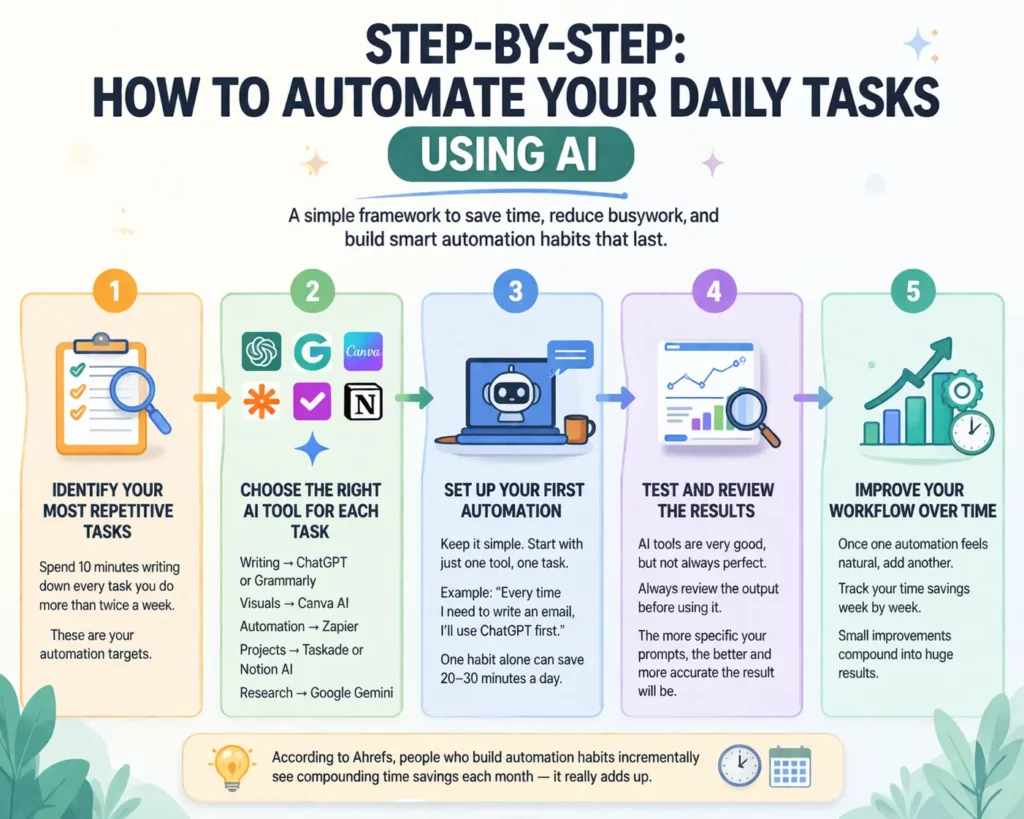
Knowing the tools is one thing. Knowing how to build a real routine around them is another. Here’s the simple framework I use and recommend to anyone starting with AI automation tools for beginners.
Step 1 — Identify your most repetitive tasks
Spend 10 minutes writing down every task you do more than twice a week. Things like replying to similar emails, writing social captions, summarising meeting notes, or creating weekly reports. These are your automation targets.
Step 2 — Choose the right AI tool for each task
Use the list above as your guide. Writing tasks → ChatGPT or Grammarly. Visual content → Canva AI. Workflow connections between apps → Zapier. Project planning → Taskade or Notion AI. Research and questions → Google Gemini.
Step 3 — Set up your first automation
Keep it simple. Start with just one tool, one task. Don’t try to overhaul everything at once. For example: “Every time I need to write an email, I’ll use ChatGPT first.” That one habit alone can save 20–30 minutes a day.
Step 4 — Test and review the results
AI tools are very good, but they’re not always perfect. Always review the output before using it. The more specific your instructions (called “prompts”), the better and more accurate the result will be.
Step 5 — Improve your workflow over time
Once one automation feels natural, add another. Track your time savings week by week. According to Ahrefs’ blog (https://ahrefs.com/blog), people who build automation habits incrementally see compounding time savings each month — it really adds up.
Common Mistakes Beginners Make with AI Tools
Most people who give up on save time using AI tools don’t quit because the tools don’t work. They quit because they started in the wrong way. Here’s what to watch out for:
Using too many tools at once
Downloading five apps on day one is overwhelming. Pick one tool, get comfortable with it, then gradually add more. Speed comes with consistency, not quantity.
Expecting instant perfect results
AI outputs are excellent starting points — not finished work. You still need to read, edit, and make the content your own. Especially for anything that goes public.
Ignoring the free plan limitations
Free plans have caps. If you suddenly hit a limit mid-task, it can be frustrating. Know the limits of each tool before you rely on it for important work.
Skipping the basics
Before you can automate daily tasks with AI, you need to understand what each tool does best. Spend just 20 minutes exploring each tool before depending on it for real work.
Not reviewing AI output before using it
One thing I noticed with beginners: people sometimes publish AI-generated content without editing it first. This almost always shows — and it can seriously damage your credibility and website quality score.
Pro Tips to Save More Time Using Free AI Tools for Beginners to Automate Daily Tasks Without Coding
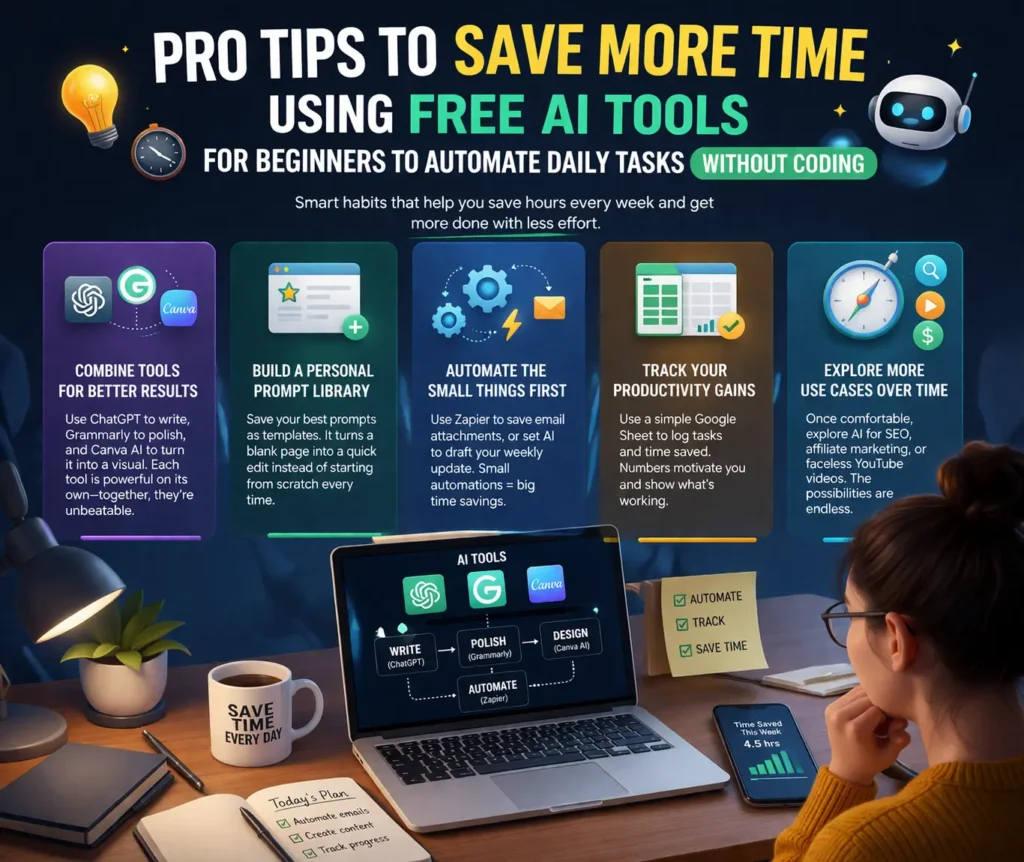
Ready to go beyond the basics? These are the habits that separate casual users from people who genuinely save hours every week. For deeper reading, check out Ahrefs’ blog and explore what’s trending in AI on Google Trends.
Combine tools for better results
Use ChatGPT to write your content, Grammarly to polish it, and Canva AI to turn it into a visual. Each tool does one thing brilliantly — combine them and the result is much better than using any single tool alone.
Build a personal prompt library
Save your best prompts as templates. Something like “Write a LinkedIn post about [topic] in a conversational tone for a small business audience” takes one quick edit instead of starting from scratch every single time.
Automate the small things first
The biggest wins often come from tiny automations. Zapier saving email attachments automatically, AI drafting your weekly update email — small changes done consistently add up to hours saved every month.
Track your productivity gains
Use a simple Google Sheet to log the tasks you’ve automated and roughly how much time each one saves you. Seeing real numbers motivates you to keep going — and helps you identify what to tackle next.
Explore more use cases over time
Once you’re comfortable with the basics, you can explore more advanced possibilities like free AI tools for keyword research and SEO, free AI tools for affiliate marketing, or even free AI tools for faceless YouTube videos without credit card. The ecosystem is enormous and growing fast.
Frequently Asked Questions
Are free AI tools safe for beginners to use?
Yes. The tools listed in this guide — ChatGPT, Google Gemini, Grammarly, Canva, Zapier, Notion AI, and Taskade — are all reputable platforms used by millions of people. That said, always use common sense: don’t share sensitive personal or financial information in AI chat boxes, and review the privacy policy before uploading confidential documents.
Which AI tool should an absolute beginner start with?
Start with Google Gemini or ChatGPT. Both are completely free, require zero setup, and work directly in your browser. Once you’re comfortable with a conversational AI assistant, you can expand to tools like Canva or Zapier based on what you personally need most.
Do I need any coding knowledge to use these tools?
Not at all. Every single tool on this list is designed as a no coding AI tool. If you can type a message and click a button, you can use them. Zapier has the steepest learning curve of the bunch, but even that takes around 20 minutes to get comfortable with.
Can AI fully automate all of my work?
Not yet — and honestly, you probably wouldn’t want it to. AI works best as a partner, not a full replacement. It handles the repetitive, time-consuming parts so you can focus on the creative decisions, strategy, and human connection that AI genuinely cannot replicate.
Are the free plans actually enough, or will I need to pay?
For most beginners, the free plans are more than enough to get started and build real, productive habits. You may eventually hit usage limits (especially with ChatGPT or Notion AI), but by that point you’ll know exactly which tool is worth paying for — based on your own experience, not guesswork.
Are there free AI tools that don’t require a credit card?
Yes. Google Gemini, ChatGPT (free tier), Canva (free account), and Taskade all offer genuinely useful free access with no credit card required. These are the best free AI tools without credit card for anyone exploring the space for the first time.
Final Thoughts — Start Small, Save Big
The bottom line is simple. You don’t need a tech background, a big budget, or any coding skills to benefit from AI in 2026. The free AI tools for beginners to automate daily tasks without coding covered in this guide are accessible right now, genuinely useful, and completely free to try.
Pick one task you do every day that feels like a chore. Find the right tool from this list. Try it for one week.
That’s all it takes to start experiencing the real, compounding benefits of AI-powered automation in your own life and work.
The people saving the most time with AI aren’t the most technical people in the room. They’re simply the ones who started.
So go ahead — start today.