
I’ve spent the better part of two years testing, switching, and sometimes swearing at AI tools. From ChatGPT to Claude to Gemini to Perplexity I’ve probably spent more time prompting than actually working. So when people ask me which AI tool is best, I tell them the same thing every time: best for what?
Because here’s the truth nobody in the marketing department wants to say there’s no single winner. There’s only the right tool for your specific mess.Let me break down what I’ve actually found after hundreds of hours of real-world use.
The Big Four: Head-to-Head
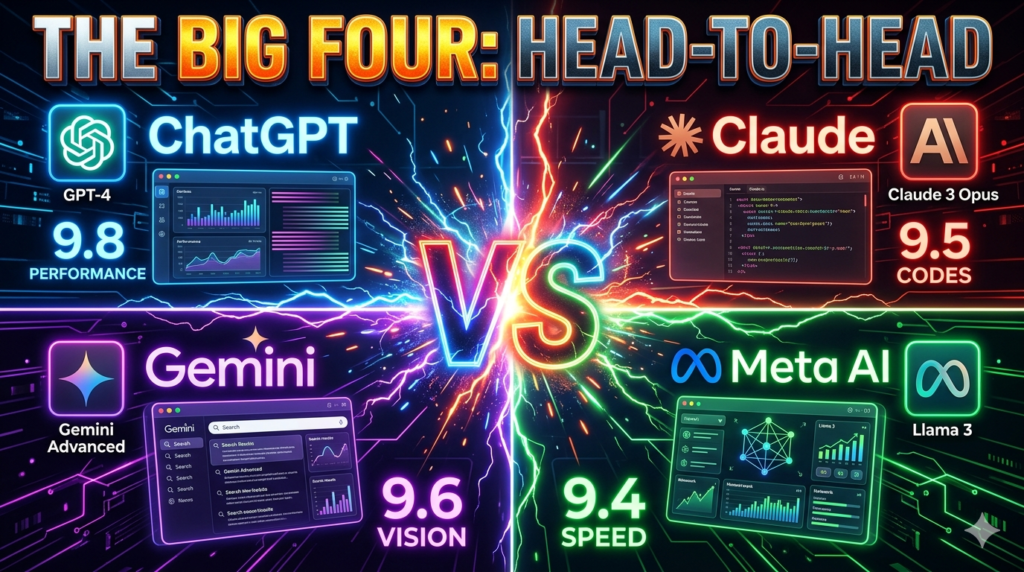
ChatGPT (OpenAI) remains the most versatile all-rounder. GPT-4o handles writing, coding, data analysis, and image generation in one interface. I use it daily for drafting emails, brainstorming, and even debugging Python scripts. Its strength is breadth it does everything decently well. The downside? It can get lazy with long tasks, and its writing style has that recognizable AI smell if you don’t prompt carefully.
Claude (Anthropic) is the one that surprised me most. Claude 3.5 Sonnet writes more naturally than ChatGPT less robotic, more nuanced. I handed both tools the same blog brief last month, and Claude’s draft needed half the editing. It also handles massive documents better; I once fed it a 150-page PDF and it pulled out key insights without hallucinating. The catch? No image generation, and the free tier is stingy.
Gemini (Google) shines when you live in Google Workspace. If your business runs on Docs, Sheets, and Gmail, Gemini’s integration is genuinely useful not gimmicky. It pulled data from my spreadsheet and built a summary in seconds. But standalone, it still trails Claude and ChatGPT in reasoning quality. I’d rate it a solid 7.5 out of 10 for general tasks.
Perplexity AI isn’t trying to be a chatbot it’s a research engine. Ask it a question, and it scans the web, cites sources, and gives you an answer. For journalists, analysts, or anyone drowning in Google tabs, this is a game changer. I replaced at least 30% of my traditional search time with Perplexity. It’s not great for creative writing, though. Don’t ask it to draft your novel.
Niche Tools Worth Mentioning
Beyond the big names, a few specialized tools earned permanent spots in my workflow:
- Jasper: still the best for marketing teams needing brand-consistent copy at scale. Expensive, but if you’re producing 50 blog posts a month, it pays for itself.
- Midjourney: undisputed king of AI image quality. DALL-E 3 is easier to use, but Midjourney’s output looks like it came from a real photographer.
- Cursor: an AI-powered code editor that actually understands your entire codebase. I switched from VS Code and haven’t looked back. It’s not perfect for beginners, but for intermediate devs, it’s transformative.
- Otter.ai: meeting transcription that doesn’t make me want to throw my laptop. Accurate, fast, integrates with Zoom.
The Honest Limitations Nobody Talks About
Here’s where I get real with you. Every AI tool I’ve tested still hallucinates. Still. In 2025. Claude is the least prone, but I caught it inventing a court case last week. ChatGPT confidently told me a statistic that didn’t exist. Privacy is another minefield. Free tiers mean your data trains the model. I don’t paste client contracts into any public AI tool period.
Enterprise plans with data isolation exist, but they cost 3-5x more. And the biggest issue? Dependency. I’ve watched junior writers and marketers stop thinking critically because the AI gave them an answer. That’s not a tool problem that’s a people problem. But it’s real.
So Which One Should You Pick?
Here’s my practical framework:
| Your Need | Best Pick | Runner-Up |
|---|---|---|
| General writing & brainstorming | Claude | ChatGPT |
| Coding & development | Cursor + ChatGPT | Claude |
| Research & fact-checking | Perplexity | Gemini |
| Marketing at scale | Jasper | ChatGPT |
| Images & design | Midjourney | DALL-E 3 |
| Google ecosystem users | Gemini | ChatGPT |
If you can only afford one subscription? Claude Pro. Right now, in mid-2025, it gives you the best quality-to-price ratio for knowledge work.
The Bigger Picture
What’s fascinating and slightly terrifying is how fast this landscape shifts. Six months ago, everyone was betting on ChatGPT’s dominance. Now Claude has pulled ahead for writing, Perplexity owns search, and open source models like Llama 3 are catching up fast. The real skill isn’t picking a tool. It’s learning to prompt well, verify outputs, and know when to trust the machine versus when to trust your own judgment.
I tell every client the same thing: treat AI like a brilliant but occasionally lying intern. Give clear instructions, check the work, and never hand over the keys completely. That’s the comparison that actually matters.
FAQs
Q: Is ChatGPT still the best AI tool in 2025?
A: It’s the most versatile, but Claude often produces better writing and reasoning. Best depends entirely on your use case.
Q: Which AI tool is best for coding?
A: Cursor combined with Claude 3.5 Sonnet or GPT-4o. For beginners, ChatGPT’s code interpreter is more forgiving.
Q: Are free AI tools good enough?
A: For casual use, yes. For professional work, paid tiers offer better models, faster speeds, and data privacy worth the $20/month.
Q: Can AI tools replace human workers?
A: Not yet. They automate tasks, not jobs. The biggest gains come from humans using AI as a multiplier, not a replacement.
Q: How do I avoid AI hallucinations?
A: Always verify facts, especially numbers and citations. Use Perplexity for research, and never trust a single AI output on critical decisions.
