
Last year, I sat in a boardroom with the executive team of a mid-sized logistics company. The CEO leaned across the table and said, We need to be on the best AI platform. The one everyone is talking about.
I had to gently break it to him: there is no single best platform. The landscape of artificial intelligence infrastructure is incredibly fragmented, and the right choice depends entirely on your team’s technical maturity, your existing data architecture, and what you’re actually trying to solve.
If you’re looking for a magic button, you won’t find it here. But if you’re trying to navigate the complex ecosystem of enterprise machine learning, MLOps, and model deployment, let’s break down the top AI platforms based on how they actually perform in the trenches.
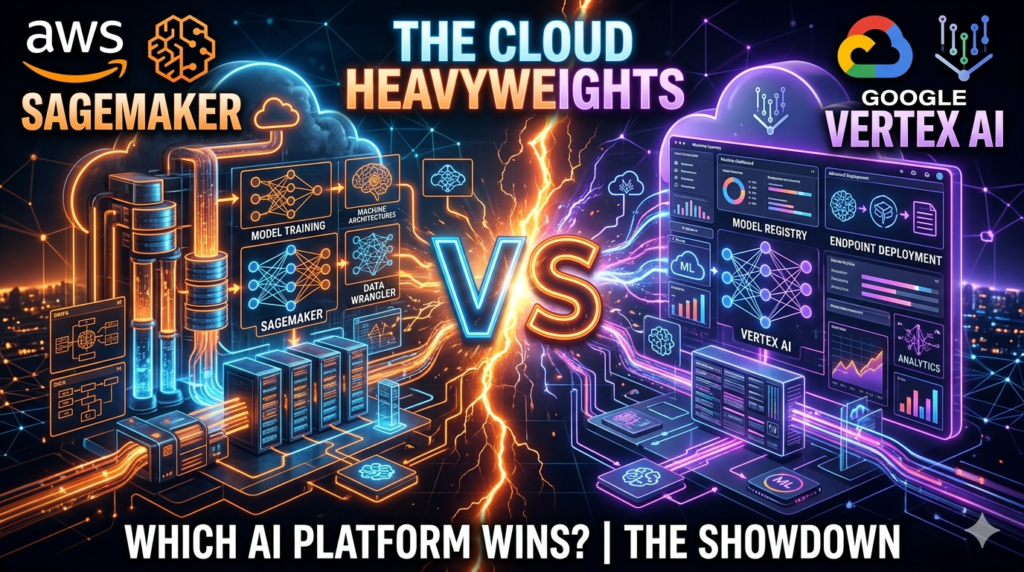
The Cloud Heavyweights: AWS Sage Maker and Google Vertex AI
When dealing with enterprise-grade AI, data gravity is a very real concept. Your data is heavy, and moving it costs time and money. Therefore, the top AI platforms for most established businesses are the ones native to their existing cloud environments.
AWS Sage Maker remains the undisputed heavyweight champion for a reason. I’ve deployed Sage Maker for retail clients needing real-time inventory forecasting. Its greatest strength is its sheer breadth it handles everything from data labeling to model training and edge deployment. However, let’s be honest about the learning curve. Sage Maker is not for the faint of heart. It requires a dedicated Mops team. If you don’t have seasoned data engineers, you will drown in the configuration options.
Google Vertex AI, on the other hand, feels a bit more cohesive, especially if your company already lives in Google Cloud Platform (GCP). Vertex shines in its integration with BigQuery. I recently worked with a healthcare analytics firm that used Vertex to train predictive models directly on petabytes of tabular data without ever having to move it. It’s a massive time-saver. Google’s auto-scaling for inference is also incredibly smooth, though you are firmly locked into their ecosystem once you commit.
The Democratizers: Hugging Face and DataRobot
Not every company has a dozen PhDs on staff, and not every project requires building a neural network from scratch. If you are doing anything related to natural language processing (NLP) or computer vision, Hugging Face is non negotiable. It’s essentially the GitHub of machine learning. Instead of training models from zero, modern AI development is about fine tuning. Hugging Face provides the hub where you can pull open source models, test them in spaces, and deploy them via their inference endpoints. The community driven nature of the platform means you are never waiting on a single vendor to innovate. The limitation? Enterprise security and compliance require you to use their Enterprise Hub or self-host, which brings you right back to needing cloud infrastructure expertise.
For teams heavily reliant on tabular data think customer churn prediction, fraud detection, or dynamic pricing Data Robot is a powerhouse in the Atom space. I’ve seen marketing teams with minimal coding experience use Data Robot to build and deploy predictive models in a fraction of the time it would take a data science team to code manually. It automates the tedious parts of feature engineering and model selection. The catch is the price tag. It’s a premium enterprise tool, and justifying the ROI can be tough for smaller organizations.
The Reality Check: Ethics, Privacy, and Hidden Costs

Here is the part of the conversation that software vendors usually skip: the hidden friction of AI deployment. When evaluating the top AI platforms, you must look past the shiny dashboards and ask the hard questions about data privacy. If you are handling sensitive customer PII or proprietary financial data, you cannot rely on black-box APIs where you lose visibility into how your data is used. Platforms like Azure Machine Learning and AWS Sage Maker offer robust private link capabilities and VPC integrations, which are mandatory for passing compliance audits in industries like finance and healthcare.
Then there’s the issue of compute costs. I’ve seen startups burn through their runway because they left high-end GPU instances running on cloud platforms after a training job finished. A good AI platform needs built-in cost governance and automated spin-downs. If the platform makes it easy to spin up a cluster but hard to monitor its burn rate, it’s a liability.
Choosing Your Path
Ultimately, selecting an AI platform is a strategic business decision, not just a technical one. If you are a tech-heavy enterprise already entrenched in AWS or GCP, lean into Sage Maker or Vertex AI. If you are a startup or an agile team building on the cutting edge of open-source models, build your pipeline around Hugging Face. And if you are a traditional business that needs rapid predictive insights from spreadsheets and databases without hiring a massive data science team, look toward Atom solutions like Data Robot.
The “best” platform is simply the one that aligns with your team’s capabilities, respects your data privacy boundaries, and actually allows you to ship models to production without losing your mind in the process.
FAQs
Q: What is the difference between Atom and platforms like AWS Sage Maker?
A: Atom (like Data Robot) automates the process of model selection and feature engineering, making it accessible to non experts. Sage Maker provides the raw infrastructure and tools for data scientists to build, train, and deploy custom models from scratch, requiring deep technical expertise.
Q: Is Hugging Face a cloud platform?
A: Not in the traditional sense like AWS or Azure. Hugging Face is primarily an open source community, model hub, and library ecosystem. However, they do offer managed inference endpoints and enterprise solutions that function similarly to cloud deployment services.
Q: How do I avoid vendor lock-in with AI platforms?
A: Rely on open-source frameworks (like Porch or Tensor Flow) and containerization (Docker/Kubernetes). If your model is packaged in a standard container, you can move it between AWS, GCP, Azure, or on-premise servers with minimal friction.
Q: Are enterprise AI platforms secure enough for healthcare or finance?
A: Yes, but only if configured correctly. Top platforms offer HIPAA and SOC2 compliance, private networking (VPC), and customer-managed encryption keys. The security burden, however, often falls on your cloud architecture team to implement these safeguards properly.
