
When I first started paying attention to AI software review platforms and tools a few years ago, I was honestly skeptical. Like many people, I had seen the hype promises of effortless automation, magical natural language processing, and smart systems that could read documents, analyze customer feedback, or even draft marketing copy in seconds. But after spending months testing a range of machine learning tools across different industries, I’ve come to a much more grounded conclusion: the best AI software isn’t the flashiest one; it’s the one that quietly solves a real problem, fits cleanly into existing workflows, and doesn’t create new headaches around data privacy, model bias, or user trust.
What “AI Software Review” Really Means
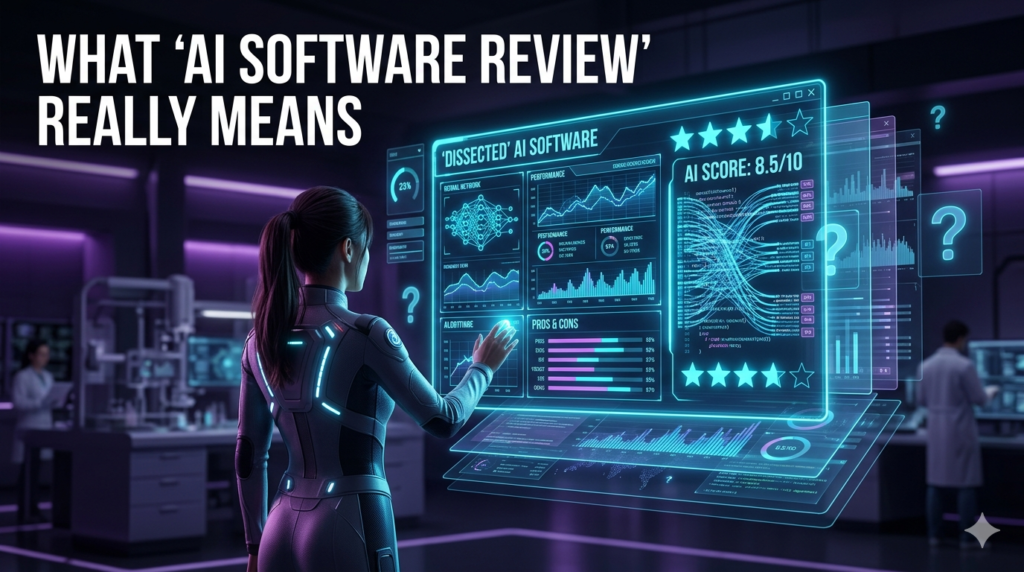
An AI software review isn’t just a star rating or a feature checklist. At its core, it’s an evaluation of how well an AI powered application performs in the messy reality of day to day work. That means looking beyond demo videos and marketing brochures to examine things like accuracy on your specific data, ease of integration with your current systems, transparency in how decisions are made, and the level of human oversight required. In practice, I treat an AI software review like a mini case study: I want to know not only what the tool can do, but who it helps, under what conditions, and at what cost financially, ethically, and operationally. For example, I recently worked with a mid sized e-commerce company that was evaluating several AI productivity tools for customer support.
Their goal wasn’t to replace agents; it was to reduce repetitive ticket triage so human staff could focus on complex, high-value conversations. The tool that impressed me most wasn’t the one with the most advanced language model on paper. It was the one that offered strong customization, clear explanations of how it categorized tickets, easy feedback loops for agents to correct mistakes, and robust controls for handling sensitive customer data. In other words, the review came down to fit, exploitability, and governance not just raw AI capability.
How I Approach Reviewing AI Software Today
When I review AI software in the current era, I focus on several practical pillars that tend to separate genuinely useful tools from overhyped ones:
- Real-world performance on relevant tasks: I always test with data that resembles what the software will actually see in production. If a tool promises to analyze contracts, I upload a sample set of real contracts complete with edge cases, inconsistent formatting, and occasional ambiguity. If it promises to support customer service, I simulate realistic customer queries, including frustrated or confusing messages. No AI system is perfect, and I pay close attention to error patterns: Does it confidently make wrong assumptions? Does it struggle with certain accents, dialects, or industry jargon?
- Integration and workflow fit: Even the smartest natural language processing engine becomes frustrating if it forces teams to change how they work overnight. I look for clean APIs, straightforward onboarding, compatibility with common tools (CRMs, helpdesks, cloud storage, collaboration platforms), and whether the software respects existing access controls. In enterprise AI environments especially, the difference between success and failure often comes down to how well the tool plugs into daily routines.
- Transparency, exploitability, and model governance: This is one area where many vendors still have room to grow. I appreciate when an AI software review highlights whether a system provides explanations for its outputs, logs decisions for auditability, allows human review before automated actions, and offers clear documentation about what data is used for training. In regulated industries healthcare, finance, legal these features aren’t optional; they’re essential for building trust with both employees and customers.
- Data privacy, security, and ethical considerations: I never ignore the uncomfortable questions. Where is data stored? Who can access it? How is consent handled? What protections exist against model bias or discriminatory outcomes? A responsible AI software review doesn’t pretend these issues don’t exist. Instead, it acknowledges trade offs and helps readers understand what safeguards are in place and what gaps might remain.
- Total cost and long-term value: Subscription pricing is only part of the story. I also consider implementation time, training needs, ongoing maintenance, and the potential hidden costs of errors (e.g., a misclassified support ticket escalating unnecessarily, or an automated compliance flag missing a critical risk). Sometimes a slightly more expensive tool pays for itself quickly because it reduces rework and builds user confidence.
A Realistic Case Study: AI for Market Research
A few months ago, I consulted with a growing SaaS company that needed faster insights from customer interviews and survey responses. They experimented with several enterprise AI platforms designed to summarize feedback, detect sentiment, and highlight recurring themes. The most impressive outcome came from a tool that combined strong natural language processing with thoughtful human in the loop design. Analysts could review AI-generated summaries, annotate them, and flag uncertainties. Over time, the system learned from those corrections, which improved its accuracy without turning the analysts into unpaid model trainers.
At the same time, the company ran into limitations. The AI sometimes overgeneralized niche user complaints, especially when feedback contained sarcasm, mixed emotions, or industry specific shorthand. It also required careful prompt tuning and ongoing governance to ensure that different team members weren’t unintentionally introducing bias by weighting certain phrases or customer segments more heavily. These challenges didn’t negate the tool’s value they simply reinforced a lesson I return to again and again in any AI software review: AI is best treated as a powerful assistant, not an infallible expert.
Balancing Hype with Caution

One reason I believe so strongly in writing authentic AI software review content is that readers deserve more than sweeping claims. Yes, automation can save hours of drudgery. Yes, modern machine learning tools can surface patterns humans might miss. But they can also amplify existing biases, generate plausible sounding but incorrect information, and create new security risks if deployed carelessly. The most trustworthy reviews I read and the ones I strive to write are those that celebrate real progress while being transparent about where the technology still stumbles.
In the current landscape, where AI capabilities evolve rapidly and regulatory expectations tighten, the best approach is continuous learning. I revisit tools periodically, talk with other practitioners, watch how vendors respond to user feedback, and update my perspectives as models, interfaces, and best practices mature. That’s what makes an AI software review genuinely useful: it reflects not a single snapshot in time, but an informed, evolving understanding of how AI fits into human work.
FAQs
Q: What should I look for in an AI software review?
A: Focus on real-world performance with your data, integration with existing workflows, exploitability and human oversight, data privacy and security practices, and the total cost of ownership not just advertised features.
Q: Are AI productivity tools worth the investment for small businesses?
A: They can be, especially for automating repetitive tasks like email triage, content drafting, data entry, or basic customer support. The key is choosing tools that integrate easily and don’t require massive changes to your processes.
Q: How can I reduce bias when using AI software?
A: Use diverse, representative training and testing data, monitor outputs for uneven performance across user groups, maintain human review checkpoints, and choose vendors that are transparent about model limitations and governance practices.
Q: Is AI software safe to use with sensitive customer data?
A: It can be, but only if the software offers strong encryption, clear data handling policies, role based access controls, audit logs, and compliance with relevant regulations. Always review the vendor’s security documentation carefully.
Q: How often should I re-evaluate AI tools I’m already using?
A: At least once or twice a year, or whenever there are major updates to the software, changes in your business needs, or new regulatory requirements. AI tools evolve quickly, and what worked well a year ago may no longer be the best fit.
