
A few years ago, AI copywriting tools were a novelty interesting, occasionally useful, but far from reliable. Today, they’re embedded in marketing workflows, startup launch plans, ecommerce product pages, and even enterprise content operations. Whether you’re a solo creator or part of a 50-person marketing team, chances are you’ve tested at least one AI writing assistant.
But the real conversation isn’t whether AI copywriting tools work. It’s how they work, when they’re effective, and where human judgment still matters most. This article takes a grounded look at modern AI copywriting tools what they’re good at, where they struggle, and how to use them responsibly and strategically.
What Are AI Copywriting Tools?
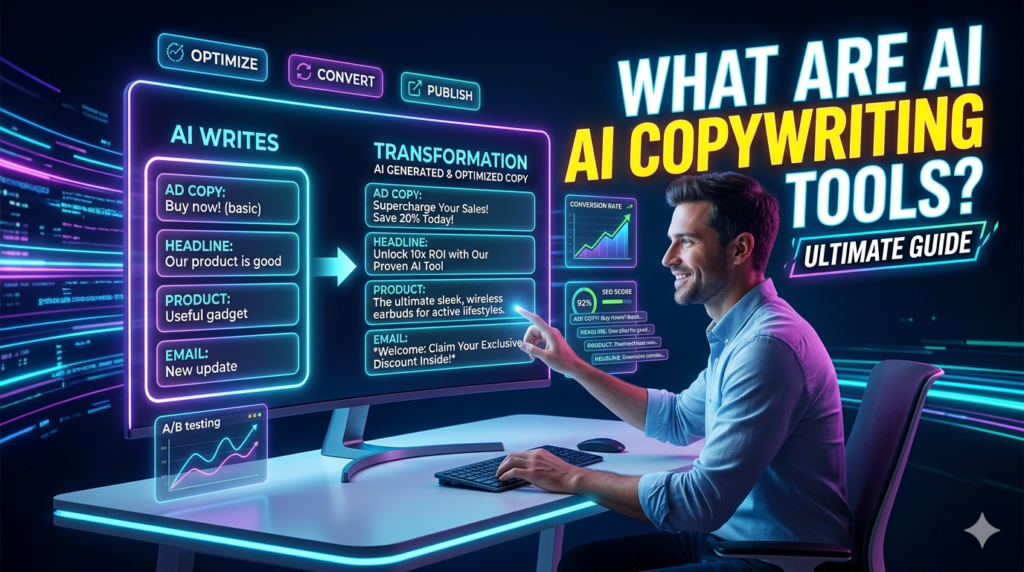
AI copywriting tools are software platforms that use large language models to generate written content. They can create:
- Blog posts
- Email campaigns
- Product descriptions
- Social media captions
- Landing page copy
- Ad headlines
- Video scripts
- SEO-optimized articles
Most tools allow users to input a prompt, keywords, tone preferences, or target audience details. The system then generates content based on patterns learned from massive datasets. Popular tools in 2026 include Jasper, Copy.ai, Write sonic, ChatGPT-based platforms, and several niche AI content generators built specifically for ecommerce, SaaS, or SEO agencies.
Where AI Copywriting Tools Excel
1. Speed and Efficiency
The most obvious benefit is speed. What once took hours like drafting 20 product descriptions or outlining a long-form blog post can now take minutes. For example, ecommerce brands with hundreds of SKUs can quickly generate baseline product copy. It may still need editing, but it eliminates the blank page problem.
For startups launching quickly, AI can generate:
- Website hero sections
- Feature breakdowns
- FAQ drafts
- Cold email sequences
This dramatically shortens time-to-market.
2. Overcoming Writer’s Block
Even experienced writers occasionally stall. AI tools are surprisingly effective brainstorming partners. They can:
- Suggest alternative headlines
- Offer different angles for a blog topic
- Rephrase complex explanations
- Generate multiple CTA variations
Often, the first output isn’t publish-ready but it sparks direction.
3. SEO Content Assistance
Many AI copywriting tools are optimized for SEO content creation. They help with:
- Keyword integration
- Meta descriptions
- Structured headings
- Topic clustering suggestions
When used correctly, AI can help build content that aligns with search intent and improves ranking potential. However, AI alone doesn’t guarantee SEO success search engines increasingly prioritize originality, authority, and user value.
4. Content Repurposing
Turning a long webinar into social posts. Converting a blog into a LinkedIn thread. Summarizing reports into newsletters. AI excels at content repurposing. This is especially valuable for brands operating across multiple platforms where consistent messaging matters.
Where AI Copywriting Tools Struggle
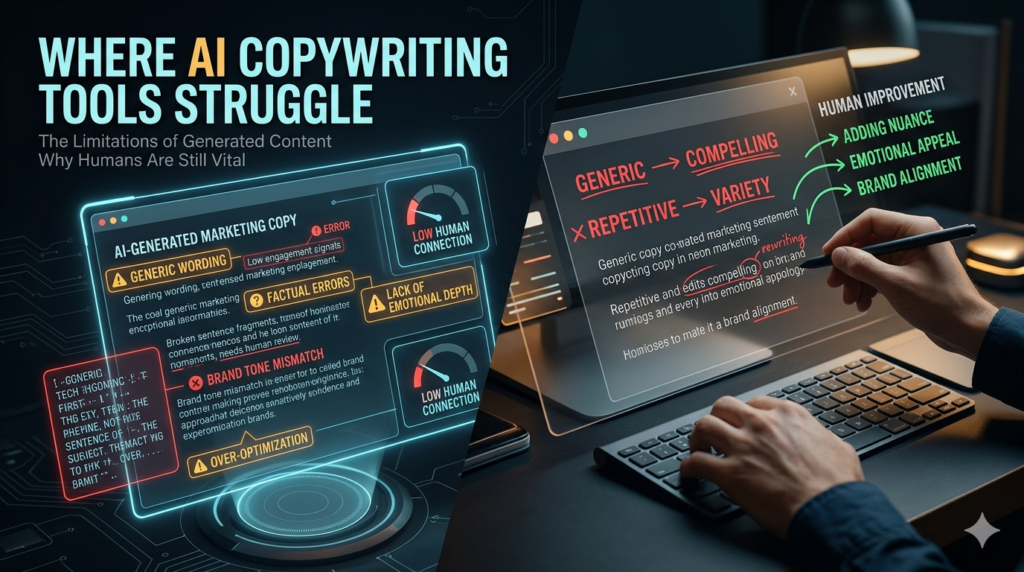
Despite the hype, AI content generators are not magic.
1. Original Insight and Deep Expertise
AI generates text based on patterns. It does not conduct interviews, perform experiments, or develop first-hand insights. Thought leadership content, industry analysis, and experience driven storytelling still require human input. Without it, content feels generic. Readers can sense the difference between surface-level summaries and content rooted in lived understanding.
2. Brand Voice Consistency
AI can mimic tone to an extent formal, conversational, witty but true brand voice goes deeper. It reflects company values, cultural nuance, and positioning.
For example:
- A cybersecurity firm writing to enterprise CTOs requires precision and authority.
- A Gen Z-focused fashion brand requires cultural fluency and playfulness.
AI often produces something acceptable but not distinctive. Without strong editing, brands risk sounding like everyone else.
3. Factual Accuracy and Hallucinations
AI models sometimes produce confident but inaccurate statements. This is particularly risky in:
- Healthcare content
- Financial advice
- Legal topics
- Technical documentation
Fact-checking remains essential. Publishing unchecked AI content can damage credibility and trust.
4. Emotional Depth
While AI can simulate emotion, it doesn’t truly understand context. Nuanced storytelling especially sensitive topics requires human judgment. A heartfelt founder story, a crisis communication message, or a deeply personal case study demands authenticity that automation struggles to replicate convincingly.
Ethical and Strategic Considerations
The rise of AI copywriting tools has also introduced ethical questions.
Transparency
Should brands disclose AI involvement? There’s no universal rule, but transparency builds trust especially in journalism, education, and research heavy industries.
Plagiarism Concerns
Reputable AI tools generate original text, but similarities can occur. Running plagiarism checks is still best practice, particularly for academic or high-authority websites.
Over-Automation Risk
Some companies publish large volumes of AI-generated blog posts hoping to dominate search rankings. In 2026, search engines are increasingly sophisticated at identifying low-value, mass-produced content.
Quality consistently outperforms quantity.
Best Practices for Using AI Copywriting Tools
Rather than treating AI as a replacement for writers, high-performing teams treat it as an assistant.
Here’s what works well:
1. Start with Clear Prompts
Vague input produces vague output. Specify:
- Target audience
- Pain points
- Desired tone
- Primary keyword
- Content goal
The more context you provide, the better the draft.
2. Edit Ruthlessly
Never publish raw AI output.
Strong editing improves:
- Clarity
- Accuracy
- Brand alignment
- Originality
The editing phase is where expertise shows.
3. Add Human Insight
Include:
- Real-world examples
- Case studies
- Data points
- Personal observations
- Industry commentary
These elements elevate AI-generated drafts into authoritative content.
4. Use AI for Structure, Not Strategy
AI can outline articles and generate frameworks. But content strategy deciding what topics matter, which audience to prioritize, and how to differentiate still requires human analysis.
Who Benefits Most from AI Copywriting Tools?
AI writing tools are particularly useful for:
- Small businesses with limited marketing budgets
- Ecommerce brands managing large product catalogs
- Agencies scaling content production
- Content marketers repurposing long-form assets
- Entrepreneurs building early-stage websites
However, highly regulated industries or thought-leadership-driven brands should use AI cautiously and with strong editorial oversight.
The Future of AI in Copywriting
AI copywriting tools are becoming more integrated, more personalized, and better at maintaining context across long documents. Some platforms now analyze brand guidelines and learn stylistic preferences over time. But the competitive advantage is shifting. When everyone has access to AI, differentiation no longer comes from generating content quickly it comes from insight, originality, and trust. In other words, AI levels the playing field. Human expertise creates the edge.
Final Thoughts
AI copywriting tools are powerful. They increase efficiency, reduce friction, and unlock creative momentum. But they are not substitutes for strategic thinking, lived experience, or editorial judgment.
The most effective approach in 2026 is hybrid:
- Let AI handle the heavy lifting.
- Let humans refine, elevate, and contextualize.
- Prioritize value over volume.
- Protect brand credibility above all.
Used thoughtfully, AI becomes not a shortcut—but a multiplier.
FAQs
Q: Are AI copywriting tools good for SEO?
A: Yes, they can help structure content and integrate keywords, but SEO success still depends on originality, expertise, and user value.
Q: Can AI replace human copywriters?
A: Not fully. AI assists with drafting and ideation, but strategy, brand voice, and nuanced storytelling still require human expertise.
Q: Is AI-generated content detectable?
A: Detection tools exist, but quality matters more than origin. Well-edited, valuable content performs better than mass-produced material.
Q: Are AI copywriting tools safe for sensitive industries?
A: They can be used cautiously, but all outputs should be carefully fact-checked, especially in legal, medical, or financial fields.
Q: What is the biggest mistake when using AI copywriting tools?
A: Publishing unedited drafts. AI content should always be reviewed, refined, and enhanced with human insight before going live.
