
I’ve been doing SEO since the days when stuffing a footer with city names could rank you nationally. So when the wave of AI SEO tools hit a couple of years back, I was skeptical. Most of it felt like repackaged keyword research with a chatbot stapled on top. But after spending real money and real hours testing dozens of these platforms across client sites and a few of my own projects, my opinion has shifted though not in the way the marketing pages would have you believe.
Let me walk you through what’s genuinely useful, what’s overrated, and how to actually fold these tools into a workflow without losing the human judgment that still separates ranking content from forgettable noise.
What “AI SEO Tools” Actually Means Now
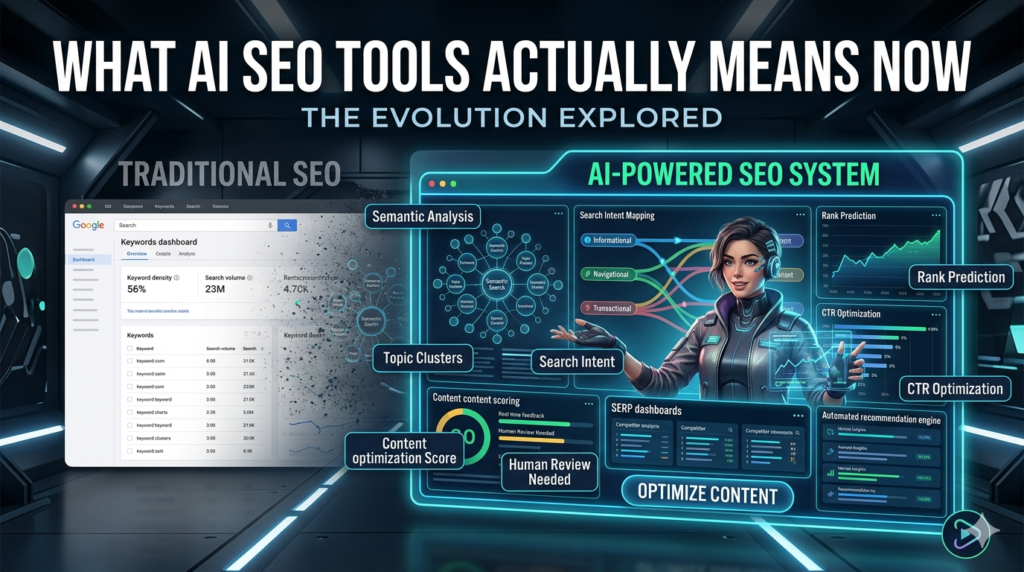
The term gets thrown around loosely. In practice, AI SEO tools fall into a few buckets:
- Content optimization platforms: Surfer SEO, Fraser, Neuron Writer, Clear scope
- All-in-one suites with AI layers: SEMrush Copilot, Ahrens AI features, SE Ranking
- AI-first content generators: Jasper, Copy.ai, Write sonic
- Technical and audit assistants: Screaming Frog with AI integrations, Site bulb
- Newer entrants focused on AI search visibility: tools like Profound and Ottery that track how your brand appears in ChatGPT, Perplexity, and Google’s AI Overviews
That last category didn’t even exist meaningfully eighteen months ago. It’s now one of the most important.
My Honest Take After Heavy Testing
The optimization tools earn their keep barely
Surfer and Frase remain my daily drivers when I’m planning content briefs. They scrape SERPs, pull entity and term data, and give you a working outline in minutes instead of the two hours it used to take me with a spreadsheet and ten browser tabs. But here’s the catch I see new writers fall into constantly: hitting a 90+ content score does not equal ranking.
I’ve published articles scoring 62 that outranked competitor pages scoring 95. The tools optimize for surface signals word frequency, headings, related terms not for genuine usefulness or original insight, which is what Google’s helpful content systems actually reward now. Use these tools as a sanity check, not a target.
AI writers still can’t replace a writer who understands the topic
I tested this last quarter on a finance client. We ran two batches of articles one written by a subject matter freelancer with light AI assistance, one written almost entirely by an AI tool and lightly edited. After 90 days, the human led batch averaged 3.4x more organic clicks. Same publishing schedule, same internal linking, same authority profile.
The AI heavy content ranked for long-tail crumbs but rarely held position one slots, and bounce rates were noticeably worse. Readers can feel filler. So can Google. What does work: using AI to draft outlines, suggest counterarguments you might have missed, summarize research papers, or rewrite clunky paragraphs you’ve already drafted.
Technical SEO is where AI quietly shines
This is the area I’ve been most impressed by. Running a 50,000-URL crawl and asking an AI layer to flag patterns orphan pages clustered in one subfolder, title tag inconsistencies across a product range, schema gaps saves hours of manual sifting. Tools like Site bulb’s recent updates and Screaming Frog combined with custom GPTs have replaced what used to be a junior analyst’s full week of work.
Tracking AI search visibility is now non negotiable
If you’re ignoring how your brand appears in AI Overviews and chat assistants, you’re missing roughly 15-30% of high intent discovery for many B2B and informational queries that number is based on what I’m seeing across my own client analytics, not a vendor whitepaper.
Profound, Ottery, and Peak AI are the ones I’ve trialed. None are perfect. Pricing is steep for what you get. But knowing whether ChatGPT recommends your product when someone asks best CRM for solo consultants is genuinely strategic intelligence.
A Realistic Workflow That Uses AI Without Losing the Plot

Here’s how I structure content production for a mid-sized client now:
- Topic discovery: Ahrefs and SEMrush for core keyword and gap data, plus prompting an AI tool to surface questions real users ask in forums and Reddit threads.
- Brief creation: Fraser pulls SERP analysis; I add the human angle: what’s missing in those ranking pages, what original data or experience I can contribute.
- Drafting: Written by a human who knows the topic. AI assists with research summaries and alternative phrasings.
- Optimization pass: Surfer or Neuron Writer checks coverage, but I ignore scores that conflict with editorial sense.
- Technical and schema: Automated audits weekly, AI summaries of crawl issues.
- Visibility tracking: Traditional rank tracking plus an AI-search monitor.
The Ethical and Practical Limits
A few things worth saying plainly:
- Mass producing AI content remains risky. Google’s March 2024 core update and the subsequent helpful content adjustments wiped out plenty of sites that scaled AI articles without expertise behind them. I’ve seen at least four clients come to me for recovery after exactly this.
- Disclosure matters. If AI contributed meaningfully to research or drafting, your editorial standards should reflect that internally even if you don’t publicize it.
- Hallucinated stats are a real problem. I caught a tool inventing a Pew Research figure that didn’t exist. Always verify numbers and quotes manually.
What I’d Recommend for Different Budgets
- Under $100/month: Neuron Writer plus a free trial rotation. Solid for solo operators.
- $200–500/month: Add Frees or Surfer, plus a proper rank tracker like SE Ranking.
- Enterprise: SEMrush or Ahrens full suite, an AI search visibility tool, and a custom crawl setup.
Don’t pay for everything. I see agencies stacking six overlapping subscriptions because someone in marketing got excited at a webinar.
Final Thought
AI SEO tools are leverage, not strategy. They speed up what a competent SEO already knows how to do and they expose the gaps in workflows that were never built on solid fundamentals. The teams winning right now aren’t the ones with the flashiest tool stack they’re the ones using AI to handle the grunt work while pouring more time into original research, real expertise, and content people actually want to read. That balance is the whole game in 2026.
FAQs
Q: Are AI SEO tools worth it for small businesses?
A: Yes, but stick to one or two affordable options like Neuron Writer or Fraser rather than over investing.
Q: Can AI-written content rank on Google?
A: It can, but pure AI content with no human expertise rarely sustains rankings after core updates.
Q: What’s the best AI SEO tool overall?
A: There isn’t one. Surfer and Fras lead for content; SEMrush and Hares for everything else.
Q: Do I need a tool to track AI Overviews?
A: If AI search drives any of your audience’s discovery, yes. Profound and Ottery are the current options.
Q: Will AI replace SEO specialists?
A: No. It’s replacing repetitive tasks, not strategy, judgment, or genuine subject expertise.
Q: How often should I run AI-powered site audits?
A: Weekly for large sites, monthly for smaller ones, with manual review of findings.
