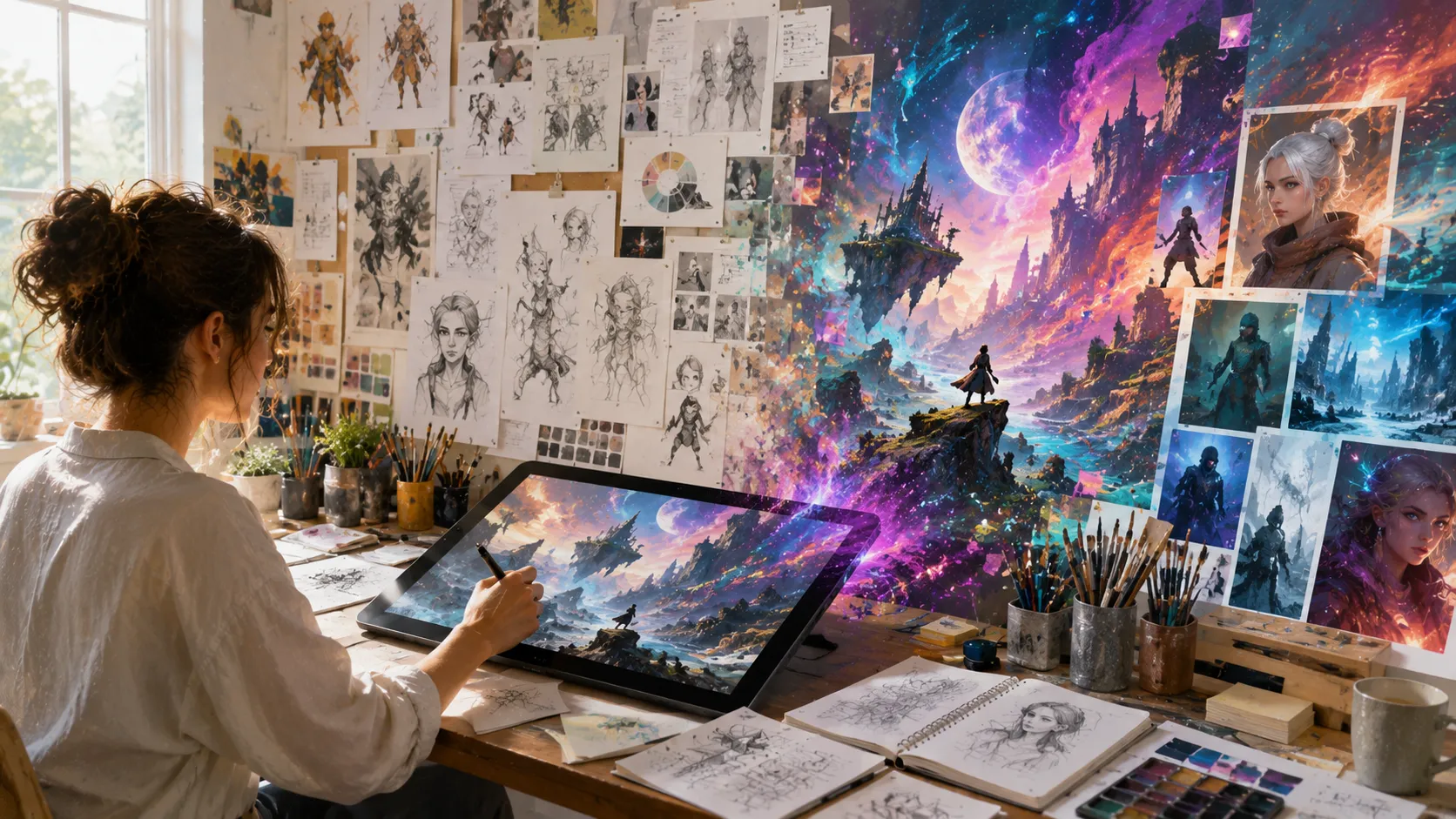
I’ve spent the better part of the last three years testing, discarding, and occasionally falling in love with AI art generators. Not in an academic, keep your distance kind of way, but as someone who genuinely wanted to understand where these tools fit into real creative work.
I’ve used them for personal projects, late night visual experiments, and once, memorably, to create a series of cover concepts for a friend’s self published poetry collection. That project alone taught me more about the messy reality of AI art than a hundred think pieces ever could.
The Shift Nobody Prepared Us For
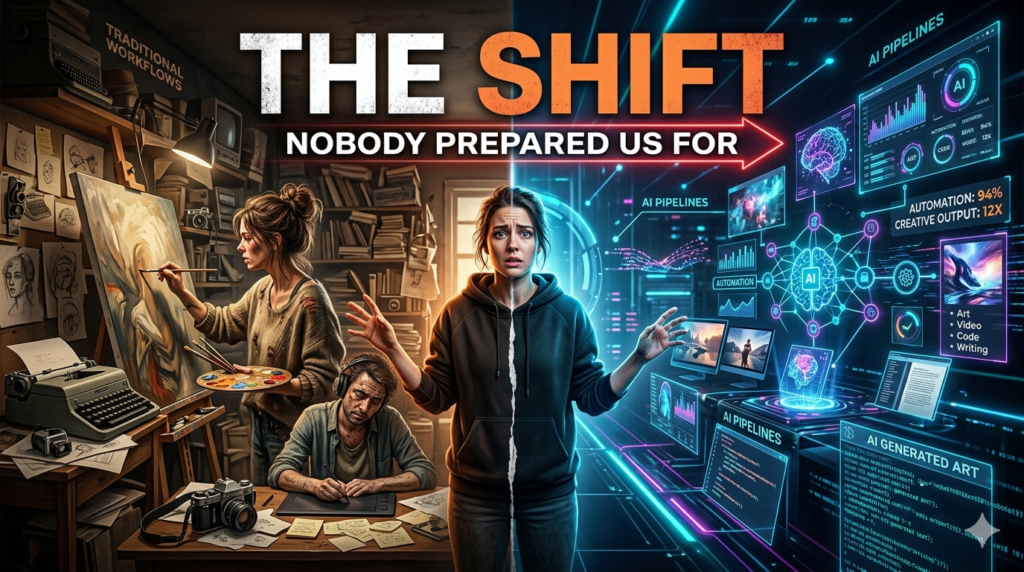
When I first opened Mid journey in mid 2022, it felt like peering into a parallel creative universe. The early outputs were weird and glitchy too many fingers, vacant eyes, bizarre architectural logic but the promise was undeniable. What’s changed since then, dramatically, is the texture of control. Early AI art felt like gambling; you threw a prompt into the void and hoped for something usable. Now, with tools like DALL·E 3, Stable Diffusion with ControlNet, and Mid journey’s latest model updates, the conversation has shifted from look what the machine made to this is what I directed the machine to refine.
This isn’t a minor tweak. It’s the difference between being a spectator and being an art director. Modern generators give you inpainting, out painting, composition references, style consistency settings, and seed controls. You can take a rough generation and massage it over a dozen iterations until it matches the image you had in your head, or something better as the unexpected emerges. I’ve spent hours doing exactly that, losing track of time the way I used to with charcoal and newsprint back in art school. The medium is different, but the focused, iterative problem solving feels eerily similar.
How These Tools Actually Work (Without the Magic Talk)
I think one of the reasons people feel alienated or suspicious of AI art is that the underlying technology gets described in mystical terms neural networks dreaming, latent space exploration. Strip that away and what you have is a diffusion model trained on hundreds of millions of image text pairs. When you type watercolor fox in a mossy forest, dappled light, Art Nouveau borders, the system isn’t thinking. It’s denoising a field of random pixels step by step until the statistical patterns match the linguistic prompt you provided. What’s genuinely impressive is the nuance that’s possible when you learn to write prompts conversationally.
I used to believe in rigid formula prompts subject, medium, lighting, style, aspect ratio and there’s still value in that for predictable outputs. But with newer models, you can just describe a mood or a memory, even imprecisely, and get startlingly coherent results. I once typed the feeling of waiting for a train in a foreign city at dusk, loneliness but make it warm into Mid journey, and what came back was so emotionally precise it stopped me cold. That moment shifted my relationship with these tools from novelty to something I take more seriously.
The Practical Reality No One Talks About
Here’s what the polished Twitter threads and YouTube tutorials rarely show: most of what an AI art generator spits out is mediocre. I’d estimate that for every ten generations I run, maybe two are worth examining closely, and one might become a starting point for further work. The ratio improves with experience and a well curated personal prompt library, but it never reaches a point where you just press a button and get a masterpiece. This is why I bristle at the narrative that AI art requires no skill.
Using these tools effectively demands visual literacy, an understanding of composition, color theory, and art historical references. You need to recognize why a generated image feels flat and know how to adjust the prompt or post process to fix it. I’ve watched people with deep art backgrounds produce stunning work in hours while newcomers flounder with the same tool, getting frustrated that the machine isn’t reading their mind. The tool amplifies taste and judgment; it doesn’t replace them.
Copyright, Ethics, and the Uncomfortable Gray Zones
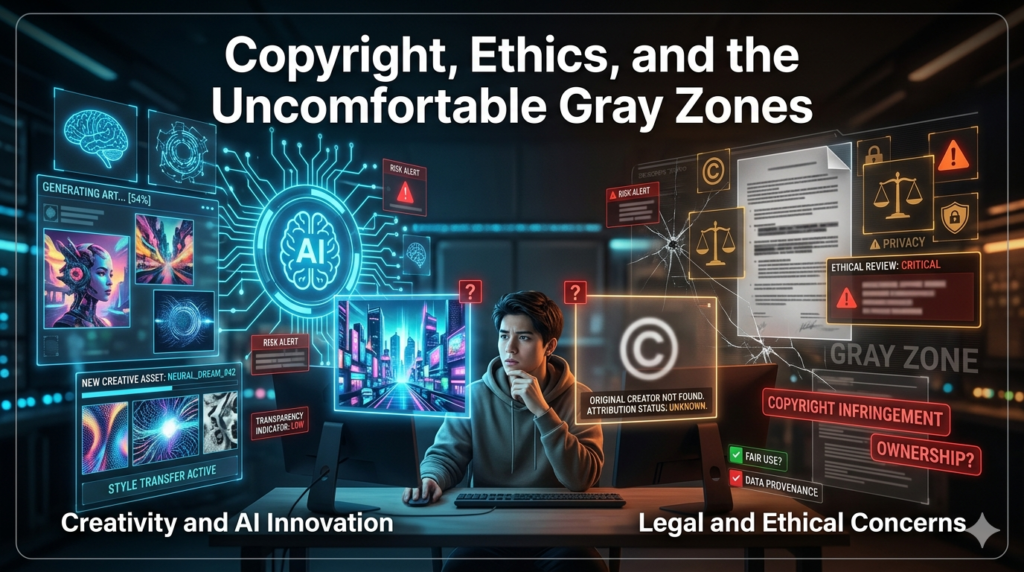
I can’t write about AI art generators without addressing the ethical elephant in the room, because it’s real and it matters. These models were trained on massive datasets scraped from the internet, containing the work of artists who never consented, were never compensated, and in many cases are now seeing AI generated imitations of their style flooding the market. I have artist friends who’ve found their names used as style prompts thousands of times. That stings genuinely it’s not abstraction when it happens to you. Some companies are trying to thread this needle with opt-out mechanisms and licensing discussions, but the damage predates these efforts.
Adobe’s Firefly, trained on licensed Adobe Stock images and public domain content, represents one attempt at a cleaner approach, and I find myself recommending it more often to professionals who need commercial safety. But even there, the broader ecosystem remains murky. If you’re generating images for anything you plan to sell, publish, or trademark, you need actual legal advice, not a platform’s marketing page. Copyright law around AI generated work is still taking shape, and assuming you have full ownership because a Toss says so is a risky bet.
Where AI Art Generators Actually Excel
Setting aside the controversies for a moment, there are places where these tools genuinely shine in ways traditional methods struggle to match. Concept exploration is the obvious one a game designer I know uses Mid journey to blast through 50 environment thumbnails in an afternoon, then paints over the strongest three in Photoshop. The AI acts as a visual brainstorming partner, not a replacement for craft.
I’ve also seen small business owners without design budgets create usable social media graphics, mood boards, and placeholder assets that would have cost thousands to commission or license. That democratization is real, even if it’s uncomfortable for working illustrators. And in purely personal creative play making images that have no commercial purpose, just the joy of seeing a strange idea rendered beautifully I think these generators are an unqualified delight. Not everything has to be a product.
The Limitations That Keep Me Honest
For all the progress, AI art generators still struggle with narrative coherence. Ask for a complex scene with specific character interactions, and you’ll get beautiful nonsense figures that almost relate but don’t, gazes that miss by inches, hand gestures that crumble under scrutiny. Text rendering has improved but remains unreliable. And the subtle, lived in quality that comes from an artist’s hand making thousands of micro decisions over hours isn’t replicable by statistical prediction. I’ve also noticed, increasingly, a kind of aesthetic convergence.
Because these models are trained on popular, high-engagement images, there’s a gravitational pull toward certain looks hyper realistic fantasy, slick digital concept art, atmospheric but emotionally vacant landscapes. Breaking out of that requires deliberate effort and often hybrid workflows that involve photography, 3D base meshes, or hand painted inputs. The best AI artists I know are the ones who were already strong artists before these tools existed.
What I’d Tell Someone Starting Today
If you’re curious, start with a tool that matches your temperament. Midjourney produces the most aesthetically refined results with minimal effort but lives inside Discord, which some people loathe. DALL·E 3, integrated with ChatGPT, excels at following complex natural language instructions and is ideal if you want conversational refinement. Stable Diffusion, run locally through something like Automatic1111 or ComfyUI, offers terrifying levels of control but requires technical willingness and decent hardware.
Spend your first weeks just playing, without productive goals. Build a personal library of prompts that surprised you. Learn to see the failures as information. And if you’re an artist feeling threatened, I understand but I’d also suggest that learning even the basics now will give you more agency than pretending these tools don’t exist. The genie isn’t going back in the bottle, but how we use it, regulate it, and build creative cultures around it is still being decided.
FAQs
Q: Do I own the images I create with an AI art generator?
A: It depends on the platform’s terms, the jurisdiction you’re in, and how much human authorship you can demonstrate. In the US, purely AI generated images currently can’t be copyrighted, but images substantially modified by a human may qualify. Always read the specific Toss and consult a lawyer for commercial work.
Q: Which AI art generator is best for beginners?
A: DALL·E 3 via ChatGPT is the most straightforward for natural language prompts without learning complex syntax. Mid journey offers higher aesthetic quality but has a steeper interface learning curve due to Discord.
Q: Can AI art generators create consistent characters or styles?
A: With effort, yes. Tools like Mid journey allow seed parameters and style reference images, while Stable Diffusion lets you train custom Lora models to maintain character consistency. It takes experimentation, but repeatable results are achievable.
Q: Are there any ethical AI art generators?
A: Adobe Firefly is trained on licensed and public domain content, making it one of the safer choices for commercial use. However, no tool is entirely free of ethical debate given the broader impacts on creative labor markets.
Q: Why do AI-generated hands still look wrong?
A: Hands involve complex articulations with high variability in training data, frequent occlusions, and small relative size in many images. Newer models have improved significantly, but errors persist, especially in nuanced gestures or interactions.
Q: Can I use AI art for book covers or merchandise?
A: Yes, many people do, but you need to investigate the specific platform’s commercial license and understand that pure AI outputs may not be fully copyrightable. Some print on demand services also have evolving policies regarding AI generated designs.
