
When I first started working in digital marketing, I used to spend hours drafting, rewriting, and polishing emails sales outreach, customer support replies, follow-ups with clients, even internal team updates. It wasn’t just the writing that drained me; it was the constant context-switching. I’d jump from one thread to another, trying to match the right tone, remember previous conversations, and avoid sounding like a robot.
That’s when I began experimenting with an AI email writer to see if it could genuinely help rather than just churn out generic messages. Over time, I learned that an AI email writer isn’t magic, but when used thoughtfully, it can become one of the most practical tools for email productivity, helping professionals communicate faster while still sounding human.
What an AI Email Writer Really Is
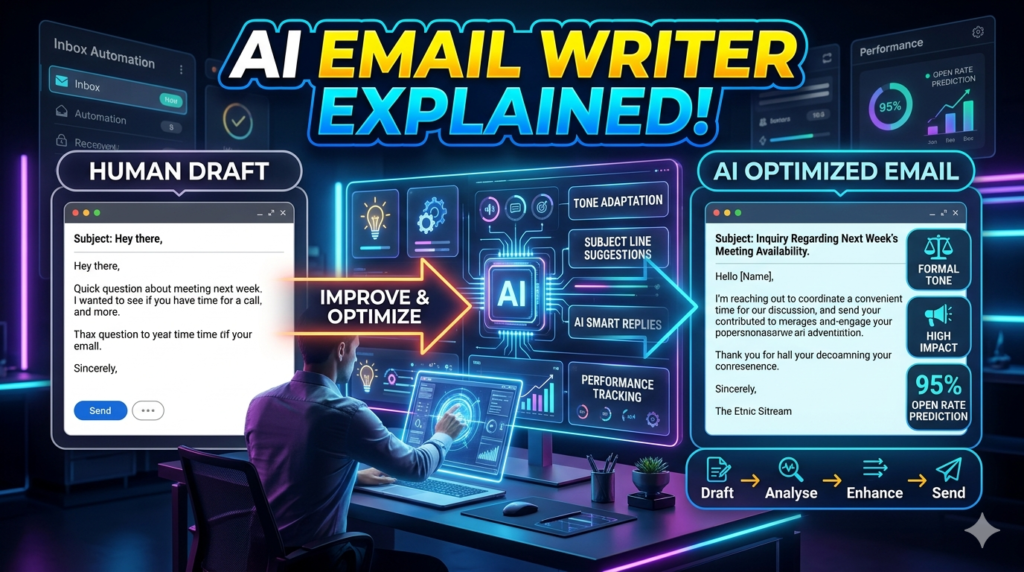
At its core, an AI email writer is software that uses natural language processing to help you generate, improve, or personalize email drafts based on a few inputs—your goal, key details, audience, and preferred tone. Unlike simple templates, a good AI email writer can adapt phrasing to different contexts: a friendly follow-up to a warm lead, a polite escalation to customer support, a concise meeting request, or a more persuasive cold outreach message. In today’s tools, many AI email writers also integrate directly with email platforms, CRMs, and productivity suites, which means you can pull in context like previous conversations, product details, or customer history to create messages that feel relevant rather than templated.
I remember working with a small e-commerce brand struggling to keep up with customer inquiries during a seasonal sale. Their support team was overwhelmed, and response times were slipping. By introducing an AI email writer trained on their past support interactions, we were able to generate first drafts for common questions shipping delays, return policies, sizing help while leaving room for agents to add empathy and specific details. Within two weeks, average response time dropped noticeably, and customer satisfaction scores didn’t just hold steady; they improved slightly because replies were faster and more consistent.
How It Works in Real Life: Experience and Expertise
What makes an AI email writer genuinely useful is its ability to combine structure with personalization. When I craft a prompt, I try to be specific: Who am I writing to? What’s the goal (inform, persuade, confirm, apologize)? What’s the key information to include? What tone should it have professional, warm, direct, or a bit playful? The more context you provide, the better the output. For example, when I was helping a B2B consultant with sales emails, we fed the AI email writer details about the prospect’s company, recent news, and the specific pain point the consultant solves. The drafts weren’t perfect out of the gate, but they gave us a strong starting point clear value propositions, natural openings, and questions that invited a response.
One of the biggest advantages I’ve seen is speed without sacrificing quality. In email marketing and outreach, iteration is everything. With an AI email writer, you can generate multiple versions quickly short and punchy for mobile readers, more detailed for technical audiences, or more story-driven for relationship-building. I often run a quick test: I’ll ask for two or three variations and then choose the best one, editing lightly to match my voice. That process has saved me countless hours, especially when I’m managing multiple campaigns or responding to time-sensitive inquiries.
Benefits, Limitations, and Balanced Viewpoints
But it’s not without limitations. AI email writers can sometimes miss nuance, cultural context, or the emotional tone required in sensitive situations. I once saw a well-intentioned outreach email come across as overly aggressive because the AI interpreted urgent as pushy. That’s why human review remains essential. An AI email writer should be treated like a junior collaborator: helpful, fast, and full of ideas, but still needing supervision. Additionally, over-reliance on automation can make communication feel generic if you don’t take the time to customize and fact-check details. In my experience, the best results come from a hybrid approach AI handles the heavy lifting of first drafts and variations, while humans bring judgment, empathy, and accuracy.
Ethical considerations also matter. Using an AI email writer responsibly means being transparent about data usage and respecting data privacy. If you’re pulling customer data into an AI system, make sure you understand how that data is stored, processed, and protected. It’s also important to avoid deceptive practices never use AI to impersonate someone else or to generate misleading claims in sales emails or marketing. Trust is hard-won and easily lost, and maintaining integrity is part of what makes your communication truly effective.
Real-World Case Study: Customer Support at Scale
Let me share a realistic example from a current-era SaaS company I advised. They were receiving thousands of support tickets per month, many with similar underlying issues: onboarding questions, billing clarifications, integration setup help. By implementing an AI email writer within their support workflow, they created a system where agents could generate tailored replies in seconds, using customer-specific details pulled from their CRM. The AI didn’t replace human agents; it augmented them.
Agents focused on complex, high-empathy cases while the AI handled the repetitive, high-volume communication. The result was faster resolution times, reduced agent burnout, and a more consistent brand voice across support channels. Importantly, the company maintained strict review processes to catch errors and ensure compliance with privacy regulations an approach that built confidence both internally and with customers.
Looking Ahead: The Human Touch Still Wins
As AI email writers continue to improve, I believe their greatest value will be in freeing people from the mechanical parts of communication so they can focus on strategy, relationships, and creativity. The best emails still come from humans who understand their audience deeply who know when to be direct, when to tell a story, and when to apologize sincerely. An AI email writer can help you get there faster, but it can’t replace your judgment, your values, or your lived experience.
If you’re considering integrating an AI email writer into your workflow, start small: pick one use case where you’re spending too much time (follow-ups, customer support, cold outreach, or email marketing) and test it for a couple of weeks. Pay attention to what works, where the tone misses the mark, and how much time you actually save. With the right balance of technology and human insight, an AI email writer can become less of a novelty and more of a reliable partner in your everyday communication.
FAQs
Q: What is an AI email writer used for?
A: An AI email writer is used to draft, improve, personalize, and streamline email communication for tasks like sales outreach, customer support, follow-ups, internal updates, and email marketing.
Q: Can an AI email writer sound natural and not robotic?
A: Yes when you provide clear context, goals, and tone, and then lightly edit the output, AI-generated emails can sound very natural and human.
Q: Is it safe to use an AI email writer with customer data?
A: It can be safe if you use reputable tools with strong data privacy practices, understand how data is stored and processed, and follow your organization’s compliance and security guidelines.
Q: Will an AI email writer replace human writers and salespeople?
A: No. It’s best used as a productivity tool that handles first drafts and variations, while humans provide strategy, empathy, accuracy, and relationship-building.
Q: How can I get the best results from an AI email writer?
A: Be specific in your prompts, include relevant details and context, choose the right tone, generate multiple options, and always review for accuracy, nuance, and appropriateness before sending.
