
When I first started experimenting with an AI content generator a couple of years ago, I was honestly skeptical. As someone who has spent more than a decade working in content marketing and SEO copywriting first as a freelance writer juggling multiple clients, then as an in-house content strategist for a growing e-commerce brand I’d seen enough “magic bullet” tools come and go to know that most of them overpromise and underdeliver. Still, curiosity got the better of me. I wanted to understand whether an AI content generator could genuinely help a small team produce more consistent blog posts, product descriptions, email newsletters, and landing page copy without sacrificing quality or, more importantly, trust.
Over time, my hands-on experience with these tools has matured. I’ve used AI content generators to brainstorm outlines, draft first-pass blog introductions, generate variations of headlines and meta descriptions, repurpose long-form articles into social snippets, and even localize basic messaging for different regions. I’ve also watched colleagues some brilliant writers, others newer to the craft lean on these systems in different ways. What I’ve learned is this: an AI content generator is not a replacement for human writers, but it can be a powerful collaborator when you treat it like a junior assistant with impressive speed and a limited memory.
What an AI Content Generator Actually Does (and Doesn’t Do)
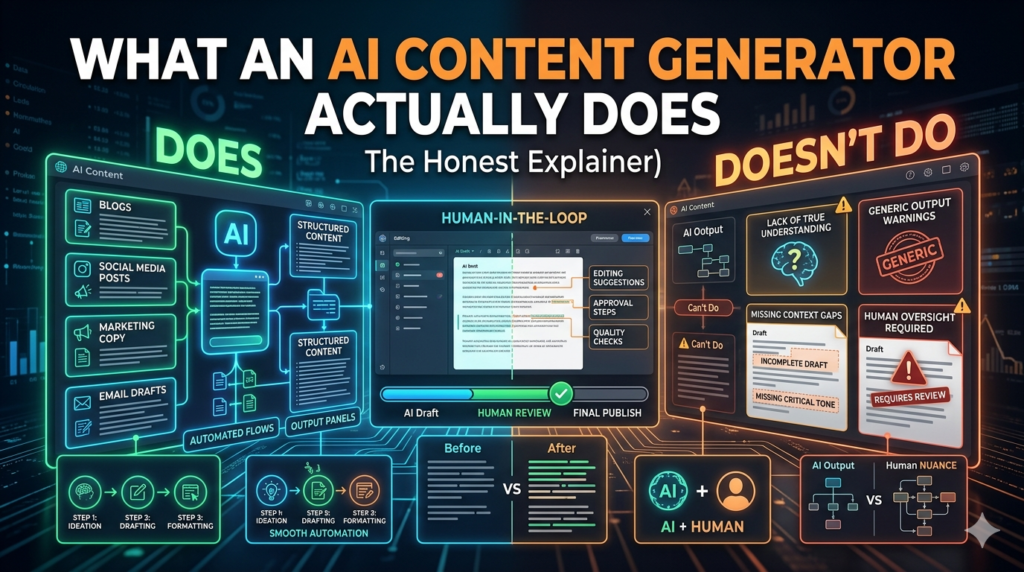
At its core, an AI content generator is a language model trained to predict and produce text based on patterns it has learned from vast amounts of existing content. In practical terms, you give it a prompt something like Write a 900-word blog post about the benefits of using an AI content generator for small businesses, including SEO tips and ethical considerations and it returns a draft that can range from surprisingly coherent to oddly generic. The best ones can mimic tone, follow structure, and adapt to style guidelines when you provide clear context. The limitations, though, are real and worth taking seriously. For one, AI content generators don’t understand your business the way a human strategist does.
They don’t know your customers’ unspoken frustrations, your brand’s origin story, the internal debates you had about pricing, or the real-world constraints your sales team faces. They can generate plausible-sounding content, but they can also confidently state outdated facts, invent statistics, or flatten nuance into bland generalizations. I remember a client in the sustainable home goods space who asked me to review an AI-generated product page draft. The copy was polished and keyword-rich, but it made sweeping environmental claims that weren’t fully backed by the company’s supply chain data. That’s when the value of human expertise really clicked for me: an AI content generator can accelerate production, but editorial review, fact-checking, and brand voice alignment are non-negotiable.
Real-World Use Cases: Where AI Content Generators Shine
One of the most compelling use cases I’ve seen is in content strategy and planning. Before drafting, many teams use an AI content generator to brainstorm topic clusters, suggest long-tail keywords, and outline pillar pages. For example, a regional fitness studio I advised used AI to generate a list of blog angles around home workouts, nutrition for busy professionals, and beginner strength training, then filtered those ideas through their own expertise to choose topics that matched their audience’s actual questions. The result was a more intentional editorial calendar and stronger topical authority exactly what search engines reward.
Another area where these tools can be genuinely helpful is repurposing and scaling content. A B2B SaaS company I worked with produces one in-depth research report each quarter. Using an AI content generator, their marketing team turned that report into a series of email nurture messages, LinkedIn carousels, short explainers for the website, and even script outlines for webinar sessions. This didn’t replace their human writers; it freed them to focus on high-value work like customer interviews, data interpretation, and narrative framing. When used thoughtfully, an AI content generator becomes less of a content factory and more of a distribution amplifier.
The SEO Angle: Optimization Without Compromising Quality

From an SEO perspective, an AI content generator can support SEO copywriting in several practical ways. It can help you draft multiple meta title and description options to A/B test click-through rates, generate schema-friendly FAQ sections, and produce variations of headings that target related search intent. I’ve also seen teams use these tools to quickly create location-based landing page drafts (AI content generator services in Austin, best AI content generator tools for e-commerce), which can be a huge time saver provided a human editor reviews for local accuracy, unique value propositions, and compliance with any advertising or legal guidelines.
That said, I’m cautious about over-optimization. In the current era of search, Google’s algorithms increasingly reward helpful, people-first content over content that exists mainly to rank. An AI content generator might crank out keyword-stuffed paragraphs that technically check boxes but feel hollow to readers. The winning approach is to use the tool to generate a solid first draft, then elevate it with original insights, case studies, expert quotes, and real examples from your own experience. For instance, when I write about AI content generators for business audiences, I always include at least one concrete story like the sustainable home goods client because specific, lived experiences build credibility in a way generic advice rarely does.
Risks, Ethics, and the Human Touch
No conversation about AI content generators would be complete without addressing plagiarism, misinformation, and brand safety. While most reputable platforms have safeguards, AI-generated text can inadvertently resemble existing content, especially when prompts are vague or overly broad. That’s why I make it a rule: every draft produced with an AI content generator goes through a plagiarism check and a careful human edit. I also treat factual claims as provisional until verified. If an AI suggests a surprising statistic or a “study shows…” line, I dig into the original source or replace it with information I can confidently stand behind.
Ethical considerations matter too. Readers deserve transparency and authenticity. In my own practice, I’m careful not to present AI-generated content as purely human-made when it hasn’t been thoroughly reviewed and shaped by human judgment. There’s also the broader question of how these tools affect creative labor. I believe the healthiest path is collaboration: AI content generators can handle repetitive drafting tasks, freeing human writers to do the work that machines struggle with—building trust, crafting distinctive brand voice, telling compelling stories, and applying ethical judgment.
A Balanced View: Experience, Expertise, and Limitations
After years of testing and refining workflows, my perspective has settled into something practical rather than ideological. An AI content generator can be an excellent brainstorming partner, a speed booster for first drafts, and a useful tool for scaling content production across channels. It can help smaller teams punch above their weight and help larger teams maintain consistency. But it cannot replace the contextual understanding, empathy, and editorial taste that come from real-world experience. The most effective content whether it’s a high ranking blog post, a persuasive landing page, or an engaging newsletter still comes from humans who understand their audience deeply and care about the impact of what they publish.
If you’re considering integrating an AI content generator into your content marketing or SEO copywriting process, start small. Pick one use case where speed matters more than nuance like drafting meta descriptions or outlining a series of educational posts and put strong human review in place. Measure results not just in volume, but in engagement, conversion, and reader trust. Over time, you’ll develop a workflow that feels less like automation for its own sake and more like a sustainable way to produce content that genuinely serves your audience.
FAQs
Q: What is an AI content generator, in simple terms?
A: An AI content generator is a software tool that uses machine learning to create text based on prompts you provide. It can help draft articles, social posts, product descriptions, and more, but it works best when guided and edited by human writers.
Q: Can an AI content generator improve SEO?
A: Yes, it can support SEO by helping with keyword-focused outlines, meta descriptions, heading variations, and content repurposing. However, strong SEO still depends on original insights, accurate information, and content that prioritizes reader value.
Q: Is content created by an AI content generator plagiarism-free?
A: Not automatically. AI-generated text can resemble existing material. It’s important to run plagiarism checks and revise thoroughly to ensure originality and to align with your brand’s voice and standards.
Q: How do I keep my brand voice consistent when using an AI content generator?
A: Provide detailed style guidelines, example passages, tone descriptors, and audience context in your prompts. Always have an experienced editor refine the output so it sounds authentically like your brand rather than generic or overly polished.
Q: Should I replace human writers with an AI content generator?
A: In most cases, no. The best results come from collaboration using the tool to accelerate drafting and ideation while human experts handle strategy, fact-checking, storytelling, ethical judgment, and final editorial polish.
